Free Weekend Fun the Nelsonatkins Museum of Art February 25
 | |
 | |
| Established | 1933 |
|---|---|
| Location | 4525 Oak Street, Kansas City, Missouri, United states |
| Coordinates | 39°02′42″N 94°34′52″Westward / 39.044973°North 94.581009°W / 39.044973; -94.581009 Coordinates: 39°02′42″N 94°34′52″Westward / 39.044973°N 94.581009°Due west / 39.044973; -94.581009 |
| Website | www |

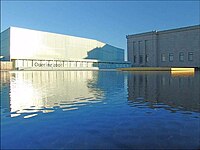
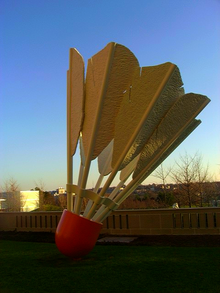
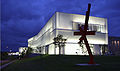
View of the museum and the Shuttlecocks installation from the due south side

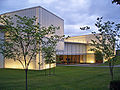
The Nelson with the new Bloch addition
The Nelson-Atkins Museum of Fine art is an art museum in Kansas City, Missouri, known for its encyclopedic collection of art from nearly every continent and civilisation, and particularly for its extensive collection of Asian art.
In 2007, Time mag ranked the museum's new Bloch Building number 1 on its list of "The ten Best (New and Upcoming) Architectural Marvels" which considered candidates from effectually the globe.[1]
On September 1, 2010, Julián Zugazagoitia (b. 1964) became the museum's fifth Director.[2] Zugazagoitia had previously served for seven years as the Director and CEO of El Museo del Barrio in New York City.
The museum is open five days a calendar week: Monday from x am-5 pm, closed Tuesday and Wednesday, open Th 10-5, Friday 10-9, Saturday and Sunday ten-five. To maintain social distancing in the galleries, visitors must reserve a timed access ticket online or past phone.
Admission is free.
History [edit]

The museum was built on the grounds of Oak Hall, the home of Kansas City Star publisher William Rockhill Nelson (1841-1915).[iii] When he died in 1915, his volition provided that upon the deaths of his wife and girl, the gain of his unabridged estate would go to purchasing artwork for public enjoyment. This bequest was augmented by additional funds from the estates of Nelson's daughter, son-in-police force and attorney.[iv]
In 1911, one-time schoolteacher Mary McAfee Atkins (1836-1911), widow of real estate speculator James Burris Atkins, bequeathed $300,000 to found an art museum. Through sound management of the estate, this amount grew to $700,000 past 1927. Original plans called for two art museums based on the split up bequests[5] (with the Atkins Museum to be located in Penn Valley Park). Even so, trustees of the two estates decided to combine the two bequests forth with smaller bequests from others to brand a unmarried major art establishment.
The building was designed by prominent Kansas City architects Wight and Wight, who too designed the approaches to the Liberty Memorial and the Kansas governor'southward mansion, Cedar Crest. Ground was broken in July 1930, and the museum opened December 11, 1933. The building's classical Beaux-Arts architecture style was modeled on the Cleveland Museum of Fine art[4] Thomas Wight, the brother who did nearly of the blueprint work for the building said:
We are building the museum on classic principles because they have been proved by the centuries. A distinctly American principle appropriate for such a edifice may be adult, but, then far, everything of that kind is experimental. One doesn't experiment with 2-and-a-half million dollars.[half dozen]
When the original edifice opened, its last cost was $2.75 1000000 (about $54 million in 2018).[4] The dimensions of the half-dozen-story structure were 390 feet (120 m) long by 175 feet (53 thousand) wide, making it larger than the Cleveland Museum of Fine art.
The museum, which was locally referred to equally the Nelson Art Gallery or simply the Nelson Gallery, was actually two museums until 1983 when it was formally named the Nelson-Atkins Museum of Art. Previously the eastward wing was called the Atkins Museum of Fine Arts, while the w fly and lobby was called the William Rockhill Nelson Gallery of Art.[vii]
On the outside of the edifice Charles Keck created 23 limestone panels depicting the march of culture from east to due west including wagon trains heading west from Westport Landing. Grillwork in the doors depict oak leaf motifs in retentivity of Oak Hall. The due south facade of the museum is an iconic structure in Kansas Metropolis that looms over a series of terraces onto Brush Creek.
About the aforementioned time every bit the construction of the museum, Howard Vanderslice donated 8 acres (32,000 mii) to the due west of the museum, across Oak Street, for the Kansas City Fine art Constitute, which moved from the Deardorf Building at 11th and Main streets in downtown Kansas City.
As William Nelson, the major contributor, donated money rather than a personal art drove, the curators were able to assemble a collection from scratch. At the peak of the Not bad Depression, the worldwide fine art market place was flooded with pieces for sale, but in that location were very few buyers. Equally such, the museum'southward buyers found a vast market open to them. The acquisitions grew quickly and within a short time, the Nelson-Atkins had one of the largest art collections in the land.[ citation needed ]
One of the original components of the building was a re-creation of Nelson's oak paneled room from Oak Hall (and namesake of the estate). The room contained Nelson's ruby plush easy chair and bookcases. The room was dismantled in 1988 to brand way for a photography studio.[iv] [8]
One-tertiary of the edifice on the showtime and 2nd floors of the w wing were left unfinished when the building opened to allow for hereafter expansion. Function was completed in 1941 to business firm Chinese painting and the remainder of the building was completed after World War Ii.[4] In 1993 Michael Churchman wrote a history of The Nelson-Atkins Museum of Art, High Ideals and Aspirations.[nine]
Directors [edit]
Paul Gardner, 1933-1953 [edit]
The museum had four Directors earlier Julián Zugazagoitia'due south appointment in 2010; the first was Paul Gardner (1894-1972). A native of Massachusetts, Gardner graduated from MIT in 1917 with a caste in architecture. He served with stardom in WWI, after which he traveled in Europe and Northward Africa for a year. In about 1919 he became a dancer with Anna Pavlova'southward Ballet Company under the name "Paul Tchernikoff". Gardner eventually went back to graduate school, earning a master's in European history from George Washington University in 1928 and and so enrolling in the doctoral programme in art history at Harvard. In March 1932 the cautious Trustees of the Nelson Fine art Gallery, hesitant virtually naming a full-fledged Director, appointed the graduate student every bit their assistant on a trial footing. Gardner took to the new position at once, and then was named by the Trustees as Manager 18 months later, on September one, 1933. He would serve for the next twenty years.[ten]
Ethylene Jackson, 1942-1945 [edit]
Ethylene Jackson (1907-1993), Paul Gardner's executive secretary since 1933, became acting manager in November 1942 when Gardner was commissioned a major in the United States Army. As well her office equally executive secretary to the Director, Jackson had served as curator of the decorative arts collection.[9] Paul Gardner served equally a Monuments Man in Europe, returning to the Nelson in December 1945. Ethylene Jackson left Kansas City for New York City the following year afterward marrying art dealer Germain Seligman.
Laurence Sickman, 1953-1977 [edit]
Upon Paul Gardner's retirement on May one, 1953, Laurence Sickman (1907-1988) became the Gallery's 2nd Director. He had been associated with the Gallery since 1931.
Laurence Sickman, a native of Denver, Colorado, had become interested in Japanese and Chinese art equally a high school student. Afterwards 2 years at the University of Colorado he transferred to Harvard, where he studied with Langdon Warner. He too became fluent in Chinese. After graduating with a B.A. in 1930 Sickman traveled to China on a Harvard-Yenching scholarship. At that place he reconnected with Warner, who was by and then in Mainland china, under consignment to buy art for the museum Trustees. Warner recommended to the Trustees that the young graduate student assume the responsibleness of negotiating art purchases for the Gallery, as Warner was moving to Japan.[xi] Sickman's apprehending as a collector earned him the respect of the Trustees, who sent him thousands of dollars with which to purchase art. Since he was on a scholarship, his expertise cost the Trustees nothing. He made the half dozen,000-mile journey to Kansas City in December 1933 for the opening of the Gallery, and so returned to China. Returning in one case more than to the United States, he was made the Gallery's Curator of Oriental Art in 1935. By 1941, Sickman'south purchases of Chinese art had given the Nelson Gallery one of the best Asian collections in the United states.[12]
Sickman, like Paul Gardner, was commissioned every bit an officeholder in the United states Army as a member of the Monuments Men, serving from 1942 to 1945 in England, India, and China. In his absence, his very capable banana, Miss Lindsay Hughes, was appointed acting Curator. Sickman returned to his curatorial role after the war; eight years later he was named Director. Amongst the many successes of his tenure, the near important was the major exhibition "Archaeological Finds of the People'due south Republic of People's republic of china", which ran from April twenty-June 8, 1975 and attracted nearly 280,000 visitors. The exhibition of 385 pieces was a result of the détente between the United States and Communist China that Richard Nixon'south 1972 trip to that country had begun. This was a professional and personal coup for Sickman: his reputation as a scholar and the drove he had built at the Nelson Gallery made Kansas Metropolis one of simply four cities the exhibition would visit, later on Paris, Toronto, and Washington, D.C.[13] Laurence Sickman retired on Jan 31, 1977, and was named Director Emeritus and advisor to the Trustees.
Ted Coe, 1977-1982 [edit]
On Laurence Sickman's retirement, Ralph Tracy "Ted" Coe (1929-2010) became the Gallery's third Director. Coe was a native of Cleveland, where his father, a steel manufacturer, was an art collector. The recipient of a available's degree in fine art history from Oberlin College and a master'southward in architecture from Yale, he had worked at the Victoria and Albert Museum in London and the National Gallery in Washington, D.C. before coming to the Nelson Gallery in 1959 as Curator of Painting and Sculpture. While a curator, Coe organized several big and well-attended special exhibitions. The most influential was "Sacred Circles", an exhibition of 900 Native American art objects. Organized to commemorate the American Bicentennial, the show opened at the Hayward Gallery in London, England, running from Oct 1976 to January 1977. Financial back up was quickly organized in Kansas City to make the Nelson Gallery the only American venue. "Sacred Circles" was the second most popular exhibition after the Chinese show of 1975, running from April sixteen-June nineteen, 1977, and cartoon more than 245,000 visitors.[ix] Ted Coe requested a breather from his duties as Managing director in March 1982 and resigned at the end of June, having worked at the Nelson for 23 years, including iv½ years as Director.[13]
Marc Wilson, 1982-2010 [edit]
Ted Coe was succeeded past Marc Wilson, who served from 1982 to 2010.[two]

A panoramic view of the backyard in front of the Nelson Atkins Museum of Art, Summertime 2008
Bloch Edifice Addition [edit]

North façade of the original building (1930-33), with the Bloch Building (1999-2007), left.

The Thinker marked the northward entrance prior to the addition of the Bloch Building when it was moved to the due south side.
In 1993, the museum began to consider the beginning expansion plans since the completion of the unfinished areas in the 1940s. Plans called for a 55 percent increment in space and were finalized in 1999.
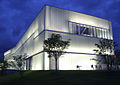
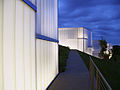
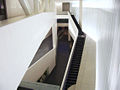
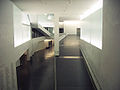
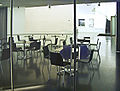
Architect Steven Holl won an international contest in 1999 for the design of the addition. Holl'south concept, conceived and realized with Design Partner Chris McVoy, was to build v glass pavilions to the east of the original building which they call lenses. The lenses acme a 165,000-square-foot (15,300 yard2) hole-and-corner building known as the Bloch Building. Information technology is named for H&R Block co-founder Henry W. Bloch. The Bloch edifice houses the museum's contemporary, African, photography, and special exhibitions galleries as well a new cafe, the museum'southward Spencer Fine art Reference Library, and the Isamu Noguchi Sculpture Court. The addition cost approximately $95 million and opened June nine, 2007. It was role of $200 million in renovations to the museum that included the Ford Learning Center which is home to classes, workshops, and resources for students and educators. It opened in fall of 2005.
In the competition to blueprint the add-on, all the entrants except Holl proposed creating a modern addition on the n side of the museum which would have drastically contradistinct or obscured the north facade which served as the principal archway to the museum. Instead Holl and McVoy proposed placing the addition on the east side perpendicular to the main building. Their aim was to engage the museum's iconic sculpture garden to fuse the experience of art, architecture and mural. Their lenses now cascade down the due east perimeter of the grounds.
During structure, Holl'south plan met with considerable controversy. It was described every bit "grotesque, a metal box."[14] Yet, reviews of the new structure once completed have generally been raves:
New York Times architecture critic Nicolai Ouroussoff gives this description:
For the art earth, the addition, known as the Bloch Building, should reaffirm that art and architecture can happily coexist. The residue of u.s.a. can draw comfort from the fact that public works of our own 24-hour interval and historic period can equal or surpass the 1000 achievements of past generations ...
The result is a edifice that doesn't claiming the by so much as suggest an alternate globe view that is in constant shift. Seen from the due north plaza, the addition'southward main entrance gently defers to the old building, the crystalline course suggesting a ghostlike echo of the ascetic rock facade. From at that place, the eye is drawn to the distinct all the same interconnected translucent blocks, which are partly buried in the landscape ...
Information technology'southward an approach that should be studied past anyone who sets out to blueprint a museum from this point forward.[15]
The museum has gone confronting traditional conservatorial thinking in allowing natural lite from the lenses to illuminate its fine art work. Almost of the exhibits in the improver are below ground with the 27 to 34-foot (10 grand) glass pavilions higher up them. Officials say that advances in glass applied science have allowed them to cake most of the harmful ultraviolet rays that could damage the exhibited works.[15]
The custom glass planks were manufactured by Glasfabrik Lamberts and imported by Bendheim Wall Systems.[xvi]
Access to the museum is costless every 24-hour interval and visitors may use any of vii entrances to access the building. The main company's desk is in the Bloch Edifice. On the n side of the museum, a reflecting pool now occupies office of the J.C. Nichols Plaza on the north facade and contains 34 oculi to provide natural light into the parking garage below. The casting of The Thinker which occupied this space prior to the renovations has been relocated to south of the museum.
In 2013, the combination of Steven Holl Architects and BNIM was selected to build a $100 meg addition to the John F. Kennedy Eye for the Performing Arts that will be modeled somewhat on the Bloch Addition.[17]


Collections [edit]
European painting [edit]

John the Baptist (John in the Wilderness), by Caravaggio, painted 1604, 1 of the works in the Nelson-Atkins'south European painting collection
The museum'south European painting collection is highly prized. It includes works by Caravaggio, Jusepe de Ribera, Jean-Baptiste-Siméon Chardin, Petrus Christus, El Greco, Giambattista Pittoni, Guercino, Alessandro Magnasco, Giuseppe Bazzani, Corrado Giaquinto, Cavaliere d'Arpino, Gaspare Traversi, Giuliano Bugiardini, Titian, Rembrandt, Louise Élisabeth Vigée Le Brun, and Peter Paul Rubens, likewise as Impressionists Gustave Caillebotte, Edgar Degas, Paul Gauguin, Claude Monet, Camille Pissarro and Vincent van Gogh, amid others.
In early on 2016, The Temptation of St. Anthony, a minor panel long attributed to the workshop of Hieronymus Bosch, was credited to the painter himself after forensic investigation of its underpainting; it was added to the ranks of merely 25 authenticated Bosch paintings in the world.[eighteen] [19] The Nelson-Atkins also has fine Belatedly Gothic and Early Italian Renaissance paintings by Jacopo del Casentino (The Presentation of Christ in the Temple), Giovanni di Paolo and Workshop, Bernardo Daddi and Workshop, Lorenzo Monaco, Gherardo Starnina (The Adoration of the Magi), and Lorenzo di Credi. It has German and Austrian Expressionist paintings by Max Beckmann, Karl Hofer (Record Player), Emil Nolde, Ernst Ludwig Kirchner and Oskar Kokoschka (Pyramids of Arab republic of egypt).
Asia [edit]
The museum is distinguished (and widely celebrated) for its extensive drove of Asian art, especially that of Regal Prc. Most of it was purchased for the museum in the early on 20th century by Laurence Sickman, and so a Harvard beau in Prc. The museum has 1 of the best collections of Chinese antique furniture in the land, including one of the historic group of glazed pottery luohans from Yixian (c. 1000). In add-on to Chinese art, the collection includes pieces from Transitional islamic state of afghanistan, Japan, India, Iran, Republic of indonesia, Korea, Pakistan, and Southeast, and South Asia.
American painting [edit]
The American painting collection includes the largest collection open to the public of works by Thomas Hart Benton, who lived in Kansas City. Amidst its collection are paintings by George Bellows, George Caleb Bingham, Frederic Church, John Singleton Copley, Thomas Eakins, Winslow Homer, and John Singer Sargent. It also has fine Gimmicky Paintings and Creations in the Bloch Building by Willem de Kooning, Fairfield Porter (Mirror), Wayne Thiebaud (Bikini Daughter), Richard Diebenkorn, Agnes Martin, Bridget Riley, and Alfred Jensen.
- American painting
-

Photography [edit]
In 2006, Hallmark Cards chairman Donald J. Hall, Sr. donated to the museum the entire Hallmark Photographic Collection, spanning the history of photography from 1839 to the nowadays day. It is primarily American in focus, and includes works from photographers such as Southworth & Hawes, Carleton Watkins, Timothy O'Sullivan, Alvin Langdon Coburn, Alfred Stieglitz, Dorothea Lange,[20] Homer Page, Harry Callahan, Lee Friedlander, Andy Warhol, Todd Webb,[21] and Cindy Sherman,[xx] among others.
Native American [edit]
In 2009, the museum opened a suite of Native American art galleries, totaling 6,100 foursquare feet, among the largest such displays in a comprehensive art museum.[22] The gallery includes the art of Jamie Okuma, a Luiseño and Shoshone-Bannock artist known for her beadwork, mixed media small sculpture, and way art.[23]
Donald J. Hall Sculpture Park [edit]
Outside on the museum'due south immense lawn, the Donald J. Hall Sculpture Park, designed by Dan Kiley, contains the largest collection of awe-inspiring bronzes past Henry Moore in the United States. The park also includes works past Alexander Calder, Auguste Rodin, George Segal and Mark di Suvero, amidst others. Across these, the park (and the museum itself) is well known for Shuttlecocks, a four-role outdoor sculpture of oversized badminton shuttlecocks past Claes Oldenburg and Coosje van Bruggen.[24]
Other [edit]
In addition, the museum also has collections of European and American sculpture, decorative arts and works on paper, Egyptian art, Greek and Roman art, modernistic and contemporary paintings and sculpture, and the art of Africa and Oceania. The museum also houses a major collection of English pottery and another of portrait miniatures.
Meet also [edit]
- Kemper Museum of Contemporary Art
References [edit]
- ^ "The x Best (New and Upcoming) Architectural Marvels". Fourth dimension. time.com. 13 Dec 2007. Archived from the original on December xvi, 2007.
- ^ a b "Julián Zugazagoitia Named Manager of The Nelson-Atkins Museum of Art" (PDF) (Press release). Nelson-Atkins Museum of Art. 5 March 2010. Archived from the original (PDF) on 27 July 2011. Retrieved 2011-03-10 .
- ^ "Architecture & History: Founders". The Nelson-Atkins Museum of Art. Archived from the original on 2011-05-19. Retrieved 2011-03-10 .
- ^ a b c d e "Nelson-Atkins Museum of Art". Kansas City Public Library Missouri Valley Special Collections. 2007. Retrieved 2011-03-10 . [ permanent expressionless link ]
- ^ "Founders-Mary McAfee Atkins". The Nelson-Atkins Museum of Fine art. Archived from the original on 2011-05-19. Retrieved 2011-03-10 .
- ^ "Original Nelson-Atkins Building-Wight and Wight". The Nelson-Atkins Museum of Art. Archived from the original on 2011-04-27. Retrieved 2011-03-10 .
- ^ "Two Buildings, One Vision". The Nelson-Atkins Museum of Art. Archived from the original on 2011-05-19. Retrieved 2011-03-10 .
- ^ Kristie C. Wolferman (1993). The Nelson-Atkins Museum of Fine art: Civilization Comes to Kansas Urban center. University of Missouri Press. p. 36. ISBN978-0-8262-0908-5.
- ^ a b c Churchman, Michael (1993). High Ideals and Aspirations. The Nelson-Atkins Museum of Fine art. pp. 98. ISBN9780942614220 . Retrieved 26 Feb 2017.
- ^ Churchman, Michael (1993). High Ideals and Aspirations. Kansas Metropolis, Missouri: The Nelson-Atkins Museum of Art. pp. 37–38. ISBN9780942614220.
- ^ Churchman, Michael (1993). High Ideals and Aspirations. Kansas Urban center, Missouri: The Nelson-Atkins Museum of Art. pp. 28–29. ISBN9780942614220.
- ^ Churchman, Michael (1993). High Ideals and Aspirations. Kansas City, Missouri: The Nelson-Atkins Museum of Art. p. 51. ISBN9780942614220.
- ^ a b Churchman, Michael (1993). Loftier Ethics and Aspirations. Kansas City, Missouri: The Nelson-Atkins Museum of Art. pp. 98, 102. ISBN0-942614-22-4.
- ^ Maria Sudekum Fisher (June 4, 2007). "Nelson-Atkins Museum previews new addition". Staten Island Advance. SILive.com.
- ^ a b "A Translucent and Radiant Partner With the Past". New York Times. NYTimes.com. June half dozen, 2007. Retrieved 2011-03-ten .
- ^ "Lamberts' Linit U-contour drinking glass" (PDF). Glasfabrik Lamberts GmbH & Co. 2007. Retrieved 2011-03-10 .
- ^ "KC firm BNIM volition assist design $100 1000000 expansion of Kennedy Center". KansasCity.com. Retrieved 2013-04-05 .
- ^ Siegal, Nina (February 1, 2016). "Hieronymus Bosch Credited With Work in Kansas Metropolis Museum". The New York Times . Retrieved February ane, 2016.
- ^ Russell, Anna (February 1, 2016). "Kansas City Museum Painting Deemed an Authentic Bosch". The Wall Street Journal . Retrieved February 1, 2016.
- ^ a b "The Nelson-Atkins Museum Acquires 800 Photographs". The New York Times. 2017-11-08. Retrieved 2020-01-02 .
- ^ Kathryn Shattuck (February 18, 2006). "For a Honey Museum: Love, Hallmark". New York Times. NYTimes.com. Retrieved 2010-10-10 .
Final month the Nelson-Atkins Museum of Art in Kansas City, Mo., acquired the complete Hallmark Photographic Collection, ... 161 by Todd Webb
- ^ "American Indian Fine art Collection". Nelson-Atkins Museum of Art. Archived from the original on May 13, 2015. Retrieved May 27, 2015.
- ^ "jamieokuma". jamieokuma . Retrieved 2017-03-11 .
- ^ Cole, Suzanne P.; Engle, Tim; Winkler, Eric (April 23, 2012). "fifty things every Kansas Citian should know". Kansas City Star . Retrieved April 23, 2012.
External links [edit]
- Official website
0 Response to "Free Weekend Fun the Nelsonatkins Museum of Art February 25"
Post a Comment